
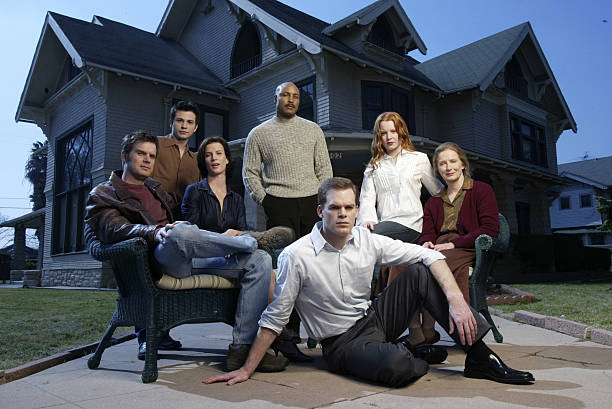
February 20, 2002–Los Angeles, California–The cast of the HBO television series “Six Feet Under” pose in front of the Fisher Funeral Home located in Los Angeles, California. The cast includes– (Clockwise from top) Mathew St. Patrick, Lauren A (Photo by Dan MacMedan/Contour by Getty Images)
The year 2001 left an indelible scar on the American psyche, reshaping how the nation dealt with grief, loss and uncertainty. Although the events of 9/11 cast a long shadow and public discussion around death was often pushed aside, Six Feet Under confronted mortality head-on, depicting a raw, honest and vulnerable portrait of how death shapes the living.
Even more, when Ball received the pitch for the show, he recalled the lasting impression funeral homes left on him as a child, compelling him to pursue this idea: “Something in my head went *click*, because I spent a fair amount of time in funeral homes when I was a kid.”
In a documentary from the series’ DVD, HBO president Carolyn Strauss recalled her first impressions when reading the script for the pilot episode “this has all the bones for a really excellent series”. Moreover, real life funeral directors praised the show for its accurate and respectful depiction of their profession on screen. Creator Alan Ball conducted thorough research on the technical aspects that come with being an embalmer, highlighting the pivotal role funeral industry professionals played on set in ensuring the show authentically portrayed their work.
The show tackles heavy subjects and it’s very important to acknowledge the writers’ best efforts to translate taboo topics such as internalized homophobia, sexuality, mental health issues into something relatable and emotionally resonant on screen. Firstly, the whole base of the show focuses on various depictions of death, grief and loss. Every subplot serves a purpose in reinforcing these ideas. For instance, Claire working through her grief with her school counselor (imposed as a consequence of her behavior) is a stark illustration of how people don’t work through their emotions, allowing them to fester and take control of their lives.
Similarly, the dynamic between David and Keith provides a sobering look into the sad reality of queer relationships: full of prejudices, discrimination and constant struggle for acceptance. Even more, Brenda’s character adds a distinctive layer of depth. Despite the extreme nature of her upbringing, she remains emotionally accessible to the audience. Her story becomes a mirror for those who have been affected by boundary crossing behavior of their parents.
The pilot episode, an Emmy-winning script by Alan Ball, perfectly encapsulates the central themes while offering viewers a solid introduction to the characters, yet still leaving room for surprises and curiosity. Diving into the series, the pilot episode plays a pivotal role in shaping the trajectory of the whole narrative. Each character’s introduction feels like a story in itself, distinct yet seamlessly woven into the larger plot. While the Fishers may seem almost numb to death through their daily work at the funeral home, nothing could have prepared them for the sudden, personal loss that strikes in the opening episode.
David presents himself as the epitome of composure and stoicism when it comes to handling death to mask his unrefined emotions: “I’ll be the strong one, the stable one, the dependable one, because that’s what I do. Everyone around me will fall apart because that’s what they do.” He treats his father’s passing with the same distant professionalism he would offer any other client, which is met with criticism by the prodigal son, Nate Jr. He takes issue to the way his brother approaches funeral services, finding it artificial and emotionally detached. His raw human emotion is transparent throughout the episode in multiple sequences where he criticizes the way his family always dodges displaying their grief in public:
“You can pump him full of chemicals; you can put makeup on him…and you can prop him up for a nap in the slumber room…but the fact remains that the only father we’ve ever gonna have is gone! Forever. And that sucks. And it’s part of life, but you can’t ever accept it without even getting your hands dirty.”
The conflict between the Fisher sons is sharply drawn in the pilot episode, rooted in their very different relationship to the family business. David sacrificed his dream of pursuing law school to run the funeral home with his father, while Nate seized his first chance to escape. Their reunion in the wake of the tragedy forces these two opposing paths to collide. Interestingly, their work dynamic carries a subtle layer of comedy. David embodies the uptight, bossy younger brother while Nate fumbles through the business with carelessness whether leaving a body unattended while on a date or cutting ill-considered deals. The pilot sets up their relationship as a volatile clash of opposing forces-one bound by duty and the other by resistance. However, as the story unfolds, the friction evolves, and the brothers begin to carve out a common ground.
The relationship dynamics in the Fisher family are defined by the death of the patriarch. The Fishers “walk on glass” around that house as Brenda described them: “No mistake, you guys are undertakers. You take every fucking feeling you have, put it in a box, and bury it.” This quote further amplifies the Fishers’ avoidance problems towards their feelings. In a house where a funeral means both a paycheck and the omnipresent reminder of mortality, the Fishers are ruled by a fear buried deep within them. They rarely express their feelings, and their interactions lack what most would call a “normal” family dynamic.
Season four delivers one of the most unconventional episodes of Six Feet Under distinguished by its unique break from the show’s usual narrative structure. Unlike the rest of the show, this episode narrows its focus and throws the viewer headfirst into a single harrowing experience. That’s My Dog takes you on an emotional rollercoaster with crippling tension that escalates scene by scene until the final moments leave you shattered and questioning why you even kept watching. (to put it plainly, this episode is emotional torture so buckle up).
What started out as an initial act of kindness toward a stranger quickly spiraled into dangerous, unimaginable circumstances. David faces life-threatening tension – forced into drugs, beaten and humiliated, while every moment brims with terrifying unpredictability. Just when it seems relief might come, the situation worsens, keeping viewers on edge until the very end. This episode proves to be a pivotal moment in David’s character arc, forcing him to battle and overcome one of the hardest traumatic episodes in his life.
Now, I have to talk about the elephant in the room – the reason why everybody and their mother is praising this show: the finale. Listen, I went into this show knowing full well that it was going to be good. Not in my wildest dreams did I expect it to be THIS good. I’m not even exaggerating. Everyone’s Waiting perfectly wraps up the show, giving each character’s story arc a fitting conclusion and ultimately leaving you as the audience in complete shambles. Seriously. The final four episodes build steadily toward the emotional crescendo, culminating in the 6-minute montage that leaves the audience utterly shattered.
I can’t even gather enough words to describe the genius of the last sequence titled “Life’s Final Arc”. The way the writers thought to carry the audience through each major character’s death was simply the only way to end the series. This sequence reinforces the central truth the show has been building all along: that death is an unavoidable and undeniable part of life. We are left with no lingering questions, no wondering- because the only certainty in life is we all end up in the same place. As Brenda states in a hallucinatory moment with Nate: “It’s all about timing.”
Claire’s final arc was equally powerful, spectacularly crafted to show her growth. The youngest family member outliving everyone she loved- I’m just at a loss for words. She represented the final act of moving on and taking a leap of faith in life. Claire abandoned her fears and everything that held her back in L.A by moving to New York, diving headfirst into the unknown. Season five perfectly captures the start of a 20 something’s career journey: she faced rough patches, had her highs and lows, but ultimately, she achieved the artistic career she had always dreamed of. (& Claire isn’t talked about enough! Her arc is amazingly depicted)
The final four episodes feature some of the most memorable quotes of the show the one that stuck with me the most (and with a lot of fans of the show) is the most popular one (basic I knooww):
“You can’t take a picture of this; it’s already gone.”
This is what Nate (as a hallucination) tells Claire when she wants to capture one last photo of her family before she moves away. Yet vague, this line seizes one important idea: everything is temporary. Every moment is fleeting. Everything we know will someday be gone. It’s a way of conveying the message that we should make the most of life while we can, because someday all will be gone. It’s a profound reminder of impermanence: urging us to be present and live authentically.
The show excels at conveying the idea that death is unavoidable and undeniable in a very quirky yet impactful manner. Each episode starts with someone dying- someone whose funeral would be handled by Fisher & Sons. The various circumstances for some of these deaths are constructed in such a ridiculous manner- they always took me aback (and that was kind of the point). Creator Alan Ball shared in the series’ documentary that the writers had a “bank” created especially for these “cold opens” if you will. They draw inspiration from internet websites dedicated to people dying in stupid ways or they would just come up with the most outrageous circumstances for someone to die. Yet again, they morphed together comedy with tragedy and dark humor in a seamless manner. The whole purpose of these scenes was to further amplify the suddenness, unexpectedness that comes with death.
Often, the deceased could reappear later in the episode as a hallucination of the Fishers, embodying the character’s fears and anxieties. These encounters spark moments of clarity, pushing the protagonists to confront personal crossroads.
A case in point is Season 1 Episode 12 entitled A Private Life which begins with the brutal murder of a homosexual young man. David Fisher had been fighting internal battles over being open about his sexuality to his family, co-workers and fellow church members throughout the season. These struggles have even cost him his relationship.
Therefore, after learning the circumstances of Marcus Foster Jr.’s death, David is filled with conflicting emotions about self-acceptance. One of the episode’s most empowering moments was David’s conversation with Federico Diaz, the gifted restorative artist at Fisher & Sons. Guided by his traditionalist beliefs, Rico complained to David about the “queerness” of the viewing service. In that moment, David fully embraces his identity, standing up to his co-worker’s homophobic comments. “I am a man”– a simple yet powerful line that captures how gay men are often demeaned and belittled.
Similarly, pressured by a hallucination of Marcus Foster Jr., David resigned as deacon for a church that opposed LGBTQ rights after coming out to his fellow clergy. This untimely event forced David to come to terms with his internalized homophobia and unresolved feelings about his faith, serving as a pivotal mark in his character development arc.
Characters who haunt the narrative carry significant weight for the Fishers. Their recurrence suggests that a character is at a decisive crossroards or is grappling with unexpressed emotions. Their presence is now lingering in their imagination, taunting them. This is the case for Nathaniel Sr. and Lisa whose appearances signal key moments in the Fishers’ individual arcs.
Nathaniel Fisher Sr. is the kind of character whose death not only sets the plot in motion, but also haunts the entire narrative, playing a crucial role in the protagonists’ subconscious mind. He appears as a hallucination to his family in moments of distress or personal crossroads, acting as an internal voice who often embodies their darkest thoughts. The conversations between Nathaniel and his family often carry a comedic note, stirring up a wave of complex emotions in his children. Nathaniel haunts his family’s minds, portraying guilt, self-hatred and unresolved emotional baggage each of them carries in the wake of his death.
However, Claire’s subconscious projects her father different than her family. Unlike her family, Claire’s mind doesn’t portray her father as a symbol that reflects internal struggles, but rather as a figure she dearly misses and longs for.
One memorable interaction between the two occurs at Nathaniel’s grave where he appears in a casual Hawaiian outfit – which could hint at his peaceful state in the afterlife or Claire’s projection of how she hopes he’s faring. Their conversation is striking in tone, casually philosophical as they reflect on the aftermath of his sudden death: “No more boredom. / No more waiting to die” – their exchange captures the final relief that comes with death, covering it in a comedic layer that perfectly highlights their unique father-daughter bond.
Nate’s hallucinations of his father reflect his own conflicted perception of their relationship. Nathaniel often addresses his son in a rather demeaning and patronizing manner- “Buddy boy” – often infantilizing him and making him feel unworthy of his pride.
In David’s case, Nathaniel embodies the fear and self-hatred he harbors towards his queerness – a part of himself his father never fully uncovered. Nathaniel represents a substantial part of David’s battle with his internalized homophobia: “It’s Fisher & Sons. That’s gotta continue. And you’re not gonna have any children”.
The use of music in the show heightens the emotional impact of a scene, effectively shaping the overall atmosphere. Several musical highlights set the stage for emotionally powerful scenes, enhancing the viewer’s connection to the characters and becoming a moment viewers revisit through the music. Season 4 episode 3 titled “Parallel Play” features a cathartic moment in the final scene. Following a garage sale, Claire sets the remaining unsold items on fire and the family gathers around in a unifying and powerful moment of catharsis. Accompanied by Radiohead’s “Lucky”, the scene becomes a symbol act of release and emotional cleansing, underscoring the characters’ shared grief and attempts at moving forward. There are plenty of other moments in the show that were enhanced by the use of a notable soundtrack. A few honorable mentions I can’t ignore are: Sia’s Breathe Me in the final montage, Nate riding a motorcycle on (Don’t Fear) The Reaper by Blue Oyster Cult and Claire and her friends singing Transatlanticism by Death Cab for Cutie. Not only did these songs make their way into my daily playlist but they also completed the scenes by building up to an emotional climax ultimately reinforcing the show’s central themes.
What makes the show’s heavy themes more digestible is its sharp use of dark humor. These outrageous situations the Fishers find themselves in are exactly what set them apart as a family of morticians. Lines like “I lost a man’s foot” and “like the bride and groom on top of the cake, and then we cremated them… what a fucking waste” inject a uniqueness and wit that wouldn’t work in any other context. Some of the most remarkably funny moments that stood out to me include Claire stealing a foot from the embalming room to punish her boyfriend and Nate getting accidentally high on ecstasy during a family dinner. The pure chaos of these scenes softens up the show’s otherwise somber tone and makes the existential weight of it all more bearable.
Another aspect that distinguishes the show’s humor and provides the audience with insights inside the characters’ minds is the use of fantasy/dream sequences. They are often used to surprise the audience (they surprised me alright) serving as red herrings. The scene gradually becomes more puzzling, only to reveal the misleading nature of the situation by having the character wake up. I particularly enjoyed the musical inspired sequences featuring David and Claire – who hasn’t slipped into a daydream of performing a Broadway show while vacuuming or stuck at a boring office job? Another memorable fantasy sequence is Ruth encountering all her past lovers and taking them down with a shotgun. Not only do they add a comic touch, but they also deepen the audience’s understanding of the characters’ psychological profile.
Moreover, Claire and Ruth bring a distinct layer of humor to the show. Claire’s deadpan realism and Ruth with her emotionally charged, often over the top reactions sprinkle the show with a uniquely enjoyable energy. The mother – daughter duo ride a wave of tumultuous changes throughout the show yet always share a magnetic connection that draws them back to one another. Moments like Claire being high on crystal meth following the news of her father’s passing – causing her to spiral into a state of chaotic grief “My father is dead and I’m high on crystal” or Ruth’s first-hand reaction to the news of her husband’s accident “Your father is dead, and my pot roast is ruined” are both absurd and strangely grounded. These reactions, while unconventional, feel rather authentic to their characters and highlight the show’s ability to balance surreal with deeply human.
Six Feet Under had me glued to the screen day and night. Its raw and honest depiction of complex human emotions offered me a new perspective on death- this inevitable, yet taboo part of life and left me with more insight than I ever expected from a television series. Weeks after watching the finale I still find myself reflecting on certain moments that struck a deep chord. You don’t need my praise to understand that this show is a truly one of a kind (and ahead of its time I would even say). But if you’ve made it till the end I’m assuming you understand where I come from. What initially hooked me were the characters. They each possessed a particular trait I found somewhat relatable, layered and worth exploring. The character dynamics were masterfully developed. Their personal journeys, their flawed yet compelling relationships made them unforgettable. David and Keith, in particular, are one of my favorite couples on TV. I’ll stop here before I write up another page. Best show ever. Bye.